
Cities and regions across Asia and the Pacific are no longer asking whether they should pursue net zero. The question before them is more practical and urgent: how can the transition to net zero be operationalized in economies where land, finance, governance capacity, infrastructure gaps, and community consent all matter at once?
Achieving net zero is not a single technical challenge. It is a governance challenge, a financing challenge, a land-use challenge, and above all, a people-centered development challenge.
There is no universal pathway to net zero. Each city faces distinct climate risks, infrastructure constraints, political economies, and social realities.
Yet one common lesson emerges: net zero succeeds when ambition is translated into institutions, finance, and local ownership.
Copenhagen’s cycling culture, for example, emerged through long-term policy alignment, protected bike infrastructure, parking restraint, and planning for walkable neighborhoods. Other cities such as Jakarta, Bengaluru and Delhi have focused on rapid expansion of metro systems and transit-oriented development to shift travel away from private cars.
Similar diversities exist in building policies. In Central Asia, older building stocks require retrofits, insulation, and heating upgrades, while Jakarta’s challenge is more about energy-efficient cooling and appliances. Waste management is also part of the climate equation, with waste-to-energy and methane capture turning landfill systems into sources of both electricity and emissions reduction. Cities are laboratories with diverse policy tools that must match local geography, history, and infrastructure.
Land is one of the most contested inputs in the clean energy transition.
Japan’s agrivoltaics development is instructive in how such trade-offs can be managed. Rather than treating farmland and solar energy as competing uses, it combines them by elevating panels above crops and carefully managing shading. This approach allows farmers to keep producing food while also earning electricity income.
Location of renewable energy projects in Australia, particularly when these are on First Nations land, raises an important issue. Renewable energy projects require fair processes, respect for cultural heritage, and real participation in decision-making and ownership. Both Japan and Australia illustrate that land access requires trust, procedural fairness, and long-term benefit-sharing between parties.
Many climate policies fail not because the technology is unavailable, but because governance is fragmented. Cities may announce ambitious targets, yet implementation slows when responsibilities are divided across agencies, when local governments lack fiscal authority, or when national and municipal policies are poorly aligned.
Copenhagen’s CPH 2025 Climate Plan offers a useful model. It is structured around three implementation phases (2013 to 2016, 2017 to 2020, and 2021 to 2025), with evaluation between phases that allows the city to refine targets and scale successful interventions. This stepwise approach reduces implementation risk while building institutional learning.
For Asian cities, this lesson is particularly relevant. Many face rapid urbanization, limited fiscal space, and high exposure to climate risks. In such contexts, governance capacity is not a secondary concern, but is the foundation of implementation.
Net zero plans should therefore not be judged only by the ambition of their targets, but by the strength of the institutions behind them. Do cities have clear mandates? Are budgets aligned with climate goals? Are agencies coordinating? Are data systems in place? Are citizens consulted? Are pilots evaluated and scaled?
Without these conditions, climate targets remain aspirational. With them, they become actionable.
Climate ambition is often ahead of climate finance. Cities know what they need to do, but the scale of investment required is large, especially for transport systems, adaptation infrastructure, renewable energy, and building retrofits.
That is where blended finance, green bonds, public-private partnerships, and multilateral support can be leveraged. Jakarta, for example, is using more sophisticated financing arrangements to support transit and resilience projects. Almaty and Astana in Kazakhstan have used green bonds for bus electrification and to modernize urban public bust transit. Indonesia’s dual-guarantee mechanism shows how risk-sharing can make projects more bankable while maintaining public oversight.
The transition to net zero must be just, not only efficient. Policies that reduce emissions but ignore livelihoods, affordability, and voice are unlikely to endure.
In agricultural areas of India, farmers do not burn crop residue because they are indifferent to pollution but because it is the cheapest and fastest option unless better tools, payments, and machinery access are available.
This same principle applies in cities. Car users, households, and communities affected by new infrastructure all respond to the fairness of the transition.
The transition to net zero will be won not by cities that wait for perfect conditions, but by those that begin, learn, adapt, and bring their communities with them.
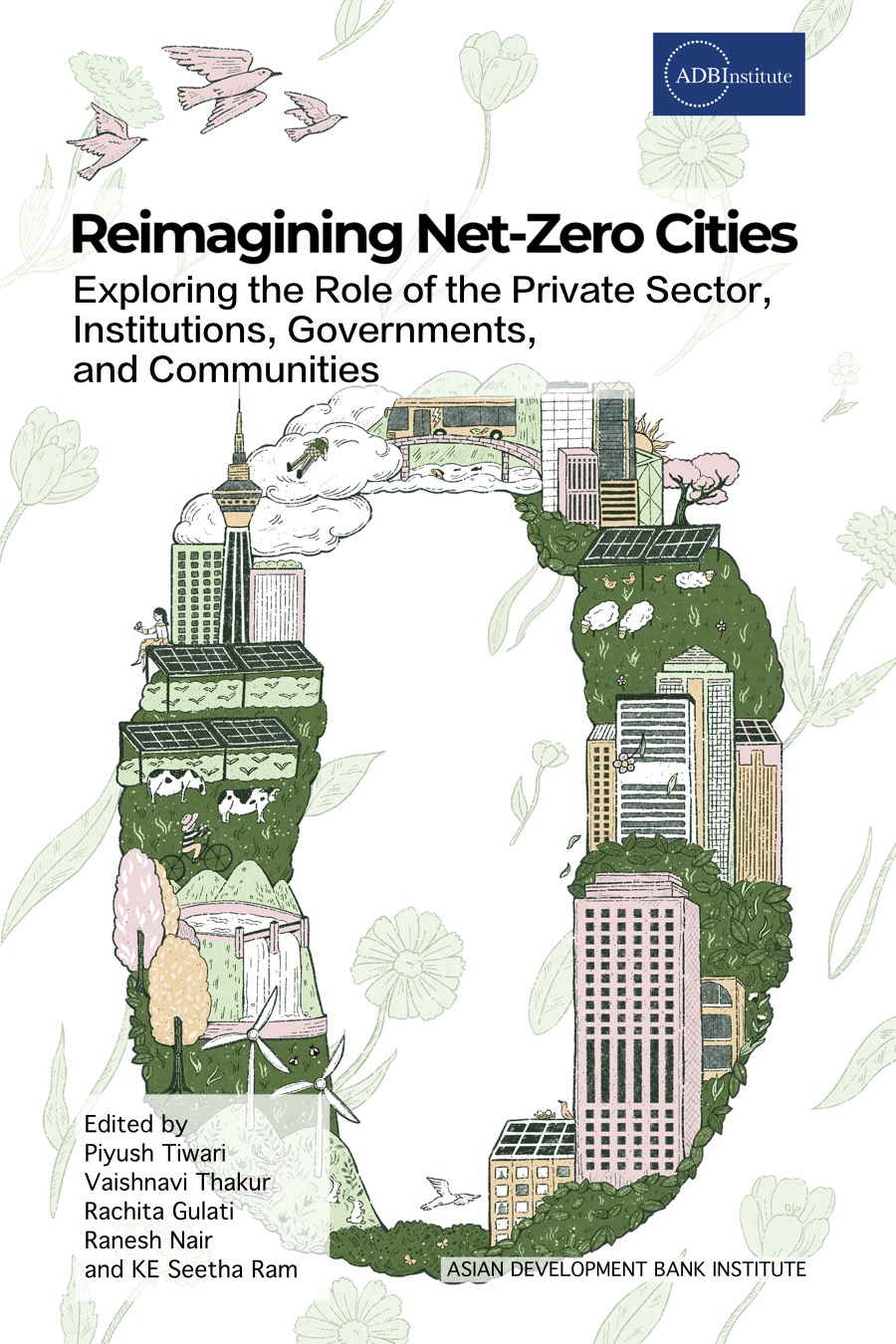
Read more in the recent ADBI publication: Reimagining Net-Zero Cities: Exploring the Role of the Private Sector, Institutions, Governments and Communities