
Climate change is reshaping labor markets. While the green transition could result in the loss of 28 million jobs globally, it could also create 100 million jobs by 2030, with new opportunities emerging in sectors such as renewable energy, sustainable construction, and circular economy services. Many of these roles, however, require new capabilities, making workforce preparation urgent.
In response, several countries are looking beyond short-term, cash-only social protection toward integrated schemes that help people adapt to a greener economy. One promising approach combines cash transfers with inclusive skills development, a model increasingly referred to as “cash-plus programs.” These programs can cushion economic shocks while also supporting reskilling and upskilling, especially for people who would otherwise be left behind in the transition.
From Cash Transfers to Capacity Building
Traditional safety nets alone may not be sufficient to support workers through the complex transitions driven by decarbonization and climate change. Cash-plus programs, which pair direct income support with complementary services such as job training, placement, and skills certification, can help advance a just and inclusive transition.
Cash transfers can alleviate poverty, but their impact is often constrained by behavioral and structural barriers. For instance, cash alone may not lead to meaningful improvements in nutrition, education, or health without accompanying changes in behavior or access to quality services such as healthcare, schools, or markets. In the context of the green transition, linking cash transfers with active labor market policies, particularly skill-building pathways, is both essential and achievable.
Green jobs call for a combination of technical skills, such as engineering, construction, and energy efficiency, and core competencies like communication, collaboration, systems thinking, and problem-solving. Together, these “green skills” support sustainable practices at work and in daily life.
Table 1: Green Skills and Jobs for a Just Transition
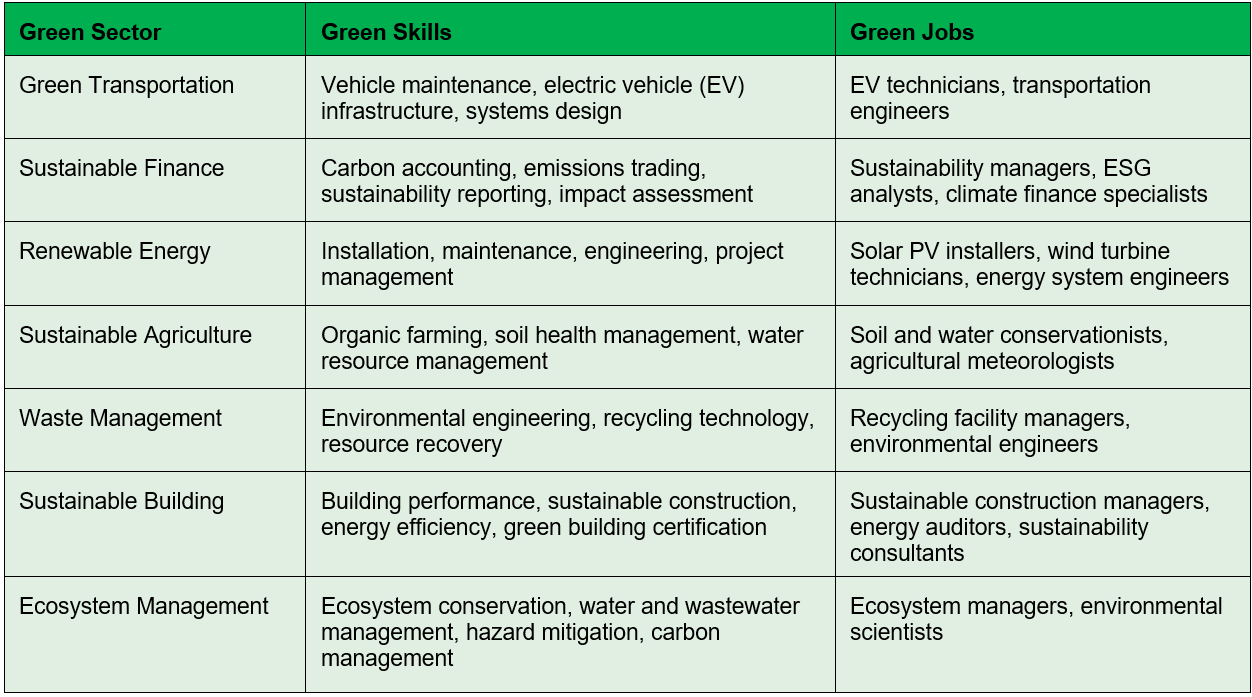
Source: UN ESCAP, ADB, and UNDP (2025), ILO (2019), LinkedIn (2024); compiled and analyzed by authors.
From Cash Transfers to Capacity Building
Across Asia and the Pacific, structural barriers continue to hinder progress toward a just transition. Nearly two-thirds of the workforce is in informal employment, and women remain significantly underrepresented in technical and green industries. Despite these challenges, country experience suggests that demand-driven training, including green-skilling initiatives, can be delivered at scale when programs are designed around real labor market needs.
Indonesia offers a leading example. Launched in 2020, Kartu Prakerja was originally designed as a skills development initiative to equip workers with job-relevant competencies. During the COVID-19 pandemic, it quickly evolved into a semi-social assistance model, combining training with elements of social assistance, targeting individuals aged 18–64 who were not in formal education.
Between 2020 and 2024, Kartu Prakerja reached more than 18.9 million beneficiaries across all provinces, including workers in both the formal and informal sectors. During the pandemic, between 2020 and 2022, beneficiaries received training vouchers worth up to Rp1 million (around $65), along with post-training incentives totaling Rp2.4 million (around $156) to serve a dual purpose: supporting household consumption while encouraging participation in learning. In the post-pandemic period, from 2023 onward, the program returned to its original focus as a skills development initiative. Beneficiaries now receive training vouchers worth up to Rp3.5 million (around $228) and Rp600,000 (around $40) in post-training incentives to support job searches or entrepreneurial efforts.
By 2024, Kartu Prakerja offered over 7,500 courses delivered by more than 500 public and private institutions. It also included 58 training programs focused specifically on green skills, aligned with Indonesia’s Just Energy Transition Partnership priorities and roadmap. The program has also demonstrated measurable results. Beneficiaries experienced a 17%–21% increase in monthly wages compared to non-beneficiaries. Beneficiaries also reported a 49% improvement in entrepreneurial skills, suggesting benefits for both wage employment and self-employment.
In other parts of the world, Pakistan’s Benazir Income Support Programme provides a compelling example of how social protection systems can evolve into platforms for economic empowerment during times of transition, including the green transition. Launched in 2008 to provide cash transfers to the ultra-poor, particularly women, the initiative has grown into a more comprehensive platform for resilience and economic inclusion. Recognizing that income support alone is rarely enough to foster long-term security, the program now incorporates complementary interventions such as skills development, productive asset transfers, and microenterprise support. These services help beneficiaries meet their immediate needs while also building sustainable livelihoods that can withstand shifting labor market demands, climate shocks, and economic uncertainty.
Cross-country evidence reinforces the case for integrated approaches. A landmark study covering Ethiopia, Ghana, Honduras, India, Pakistan, and Peru assessed the “graduation model,” a multi-component intervention combining temporary cash support with life and technical skills training, asset transfers, savings facilitation, and health services. The study found sustained gains in income, food security, mental health, and productive assets even 1 year after the program ended, suggesting that sequenced support can create lasting pathways out of poverty.
Delivering a Just and Inclusive Transition
Without deliberate policies to reskill and upskill poor and vulnerable groups, the green transition could exacerbate poverty and erode the public trust needed to sustain long-term climate action. Delivering green dividends requires equipping everyone with the means to participate and thrive. This requires systems that align social protection, skills development, and financial inclusion into integrated platforms that can support people through transitions across the course of their lifetimes.